
Published 30 October 2026
Sham decisions: a misuse of power?
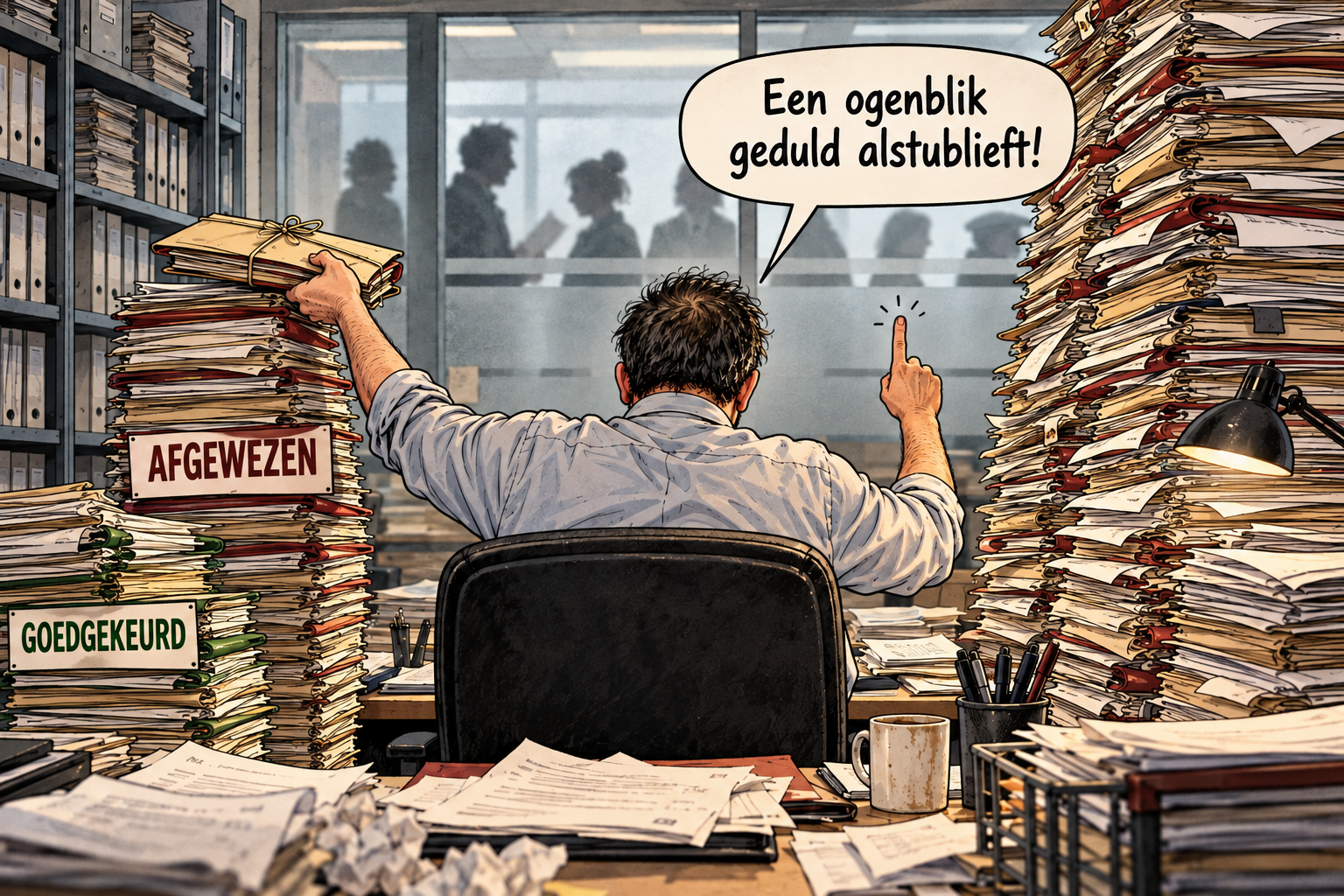
This week a client asked me whether she should serve notice of default on the government. Months ago she made an option declaration to recover the Dutch nationality she lost, unknowingly, in January, and the statutory deadline for a decision passed long ago. Legally the answer is simple: yes, she may, and the law attaches a penalty payment to it. My advice, even so, was: better not. In this article I explain why.
First, something I shall repeat more than once in this piece. This is not about immigration. It is about Dutch nationals and former Dutch nationals,* most of them born and raised in the Netherlands, and about their right to Dutch nationality. *The regulations say oud-Nederlander, literally “old Dutch national”; voormalig Nederlander, former Dutch national, is the better term.
What the law promises
The government may not take forever over a decision. For many decisions the law sets a maximum period. Where it sets none, the authority must decide within a reasonable period, and that period has in any event passed once eight weeks have gone by with no decision and no word (article 4:13 of the General Administrative Law Act, the Awb). A few examples from nationality law:
- Option: thirteen weeks from receipt of the declaration, extendable once by no more than thirteen weeks (article 6(5) of the Netherlands Nationality Act, the RWN).
- Naturalisation: one year from payment of the fee or from receipt of the further information requested, and may be held for at most two further periods of six months (article 9(4) RWN).
- Passport: four weeks (article 41(1) of the Passport Act). Even where the government first investigates whether the applicant is still a Dutch national, it remains an application on which it must decide in time; it may only suspend or extend the period as the law allows.
Once the period has passed, the person concerned may serve written notice of default on the administrative body. If it then fails to decide within two weeks, a penalty payment falls due by operation of law, up to a maximum of €1,442 (article 4:17 Awb). He or she may also go straight to the court, without first lodging an objection.
What can happen in practice
Serving a notice of default starts a two-week clock. The administrative body may use those fourteen days to decide carefully. It may also decide quickly, and in my experience and that of my colleagues a quick decision is often a refusal. A refusal stops the penalty payment just as effectively as a grant.
A decision of that kind, taken with the penalty payment in mind, is what I call a schijnbesluit: a sham decision, taken chiefly to stop the clock rather than to judge the case. That is my own term, not a legal one.
After a refusal is when it really begins: an objection, perhaps an appeal, months or even years more, and costs for the client. Once you hold a refusal, you then have to persuade the government to revise its own decision. In my experience that is harder than persuading it to get a fresh decision right.
I normally advise against a notice of default. But where clients send one anyway, or had already sent one, I see in my own practice that a striking number of the decisions that follow are weak. I had begun to suspect that they had been taken too quickly. Why, I did not at first know. When I looked further, it turned out to be an old problem.
Foreseen, measured and acknowledged
The risk has been foreseen, measured and acknowledged for a good twenty years:
- Those who introduced the Penalty Payment Act wrote it into the explanatory memorandum themselves in 2005: on receiving a notice of default an administrative body might, “in order to avoid having to pay a penalty payment, take a refusal decision quickly and possibly without proper foundation” (Parliamentary Papers II 29 934, no. 3, p. 3). They judged that risk to be small and relied on political oversight. No safeguard was written into the law.
- In its advisory opinion the Raad van State, the Council of State, asked for research into whether the penalty payment “leads to less careful decisions” (Parliamentary Papers II 29 934, no. 4).
- In a 2009 study of the Act, 12 per cent of the municipalities surveyed said themselves that time pressure leads to more refusals, and 17 per cent that the quality of decisions is under strain; among municipalities of more than 100,000 inhabitants that figure was 35 per cent (Monitor Wet dwangsom, final report, pp. 34–35). Those are the administrative bodies themselves. Self-criticism.
- The 2013 evaluation by the research centre of the Ministry of Justice found, in the minister’s own words in 2020, “that the quality of decision-making sometimes comes under pressure from the decision period” (Appendix to the Proceedings II 2019/20, no. 2609).
- The government circular directs that a notice of default be dealt with “as a priority”. It also records that the question whether a decision has been taken stands “separate” from whether it is correct (Circular on the Penalty Payment and Appeal in Cases of Failure to Decide in Time, 2019).
- A firm of immigration lawyers writes openly that lawyers are “cautious” with notices of default, “because this can sometimes lead to a hastily taken decision”.
What is missing is proof of intent. Nowhere have I found public figures on how many of the decisions taken after a notice of default are refusals. In 2017 the IND, the immigration service, could not even retrieve from its own systems the grounds on which it had refused family reunification cases (Appendix to the Proceedings II 2016/17, no. 1988).
In law, misuse of power (article 3:3 Awb) requires proof of a deliberate act for an unlawful purpose. In this article, therefore, I use the phrase in its ordinary sense and not its legal one. The purpose and the deliberate act are things I cannot prove in law. What can be done is to challenge a weak decision for what it is: inadequately prepared or insufficiently reasoned. That works too. On 5 February 2025 the Raad van State quashed a decision of the Minister of Foreign Affairs on the proportionality assessment following loss of Dutch nationality, because it had been inadequately prepared and insufficiently reasoned (ECLI:NL:RVS:2025:421). But that ruling came almost four years after the decision on the objection. Naming the problem is something I can do now.
Where it comes from – my reading
What follows is my interpretation and not a finding of fact.
Penalty payments cost the government money and are politically visible. The IND paid €36.8 million in penalty payments in 2024 and some €79 million in 2025. In February 2026 the IND’s director-general said the penalty payments should be “abolished as soon as possible” (IND annual figures 2025). In 2025 the Ministry of Foreign Affairs announced the closure of seven posts, as part of a 10 per cent cut (letter to parliament of 25 September 2025). NederlandWereldwijd, the government’s own portal, reports that applying for an option declaration “currently takes longer than usual”.
At the IND it is less a matter of cuts than of being structurally allocated too little money for the work. In its own annual plan for 2026 the IND writes that the fluctuating funding has caused “bottlenecks in the funding of the IND” and that “nothing more can be added to the IND’s plate”. It sets aside €50 million for penalty payments. In September 2025 the Netherlands Court of Audit wrote that this money does not solve the underlying problem: the IND is not dealing with asylum applications in time. It is that same IND which advises on proportionality where Dutch nationality is being recovered, and which decides on naturalisation.
Anyone taking decisions in such an organisation is under pressure not to let penalty payments mount up. Whether internal targets or performance indicators go with that, I do not know; I should like to know. I suspect that an individual decision-maker in that position is readier to choose a refusal than a penalty payment in his name. And I expect that with every further cut more Dutch nationals and former Dutch nationals will be the ones who suffer for it.
Where it bites hardest: cases with room for interpretation
A sham decision is easiest to take where the law leaves room. Two examples.
The first is the recovery of Dutch nationality following the Tjebbes judgment.
In 2019 the Court of Justice held that where Dutch nationality is lost, and with it citizenship of the Union, it must be possible to examine for each person whether that loss is proportionate (CJEU 12 March 2019, C-221/17). Since 1 April 2022 that can be done through an option (article 6(1)(p) RWN). To my mind the implementation has, in several respects, been drawn more narrowly than the judgment.
The outcome is not hard to guess. In almost 4 per cent of the recorded requests for advice the IND found the loss to be disproportionate; in 90 per cent it found that it was not (IND, Invoeringstoets Tjebbes, July 2023).
The second example is the passport application where the government doubts whether the applicant is still a Dutch national. The law allows four weeks for a passport application. One client of mine is now in the second year of his. In cases of this kind too, the government has to judge old documents and facts that can often be read two ways.
Where evidence can be read two ways, a refusal can always be reasoned. That is where the risk of a sham decision is greatest.
My advice
I am obliged to tell my clients about the notice of default. I am equally obliged to warn them about what can happen in practice. So in cases where the judgment is a balancing exercise, such as the proportionality assessment, I often advise against serving one. A quick refusal does not give the client Dutch nationality; it gives them an objection, an appeal, time and costs.
What then? All too often I ask for patience. There are other ways of getting attention for a case, but which one works has to be judged case by case. And I often have a plan B, and sometimes a plan C.
There are lawyers who will serve a notice of default without hesitation and then fight the refusal that follows through objection and appeal. Legally that is defensible. Whether it serves the client, I often doubt. For a lawyer, proceedings are work. For a client they are time, money and uncertainty. And my client’s aim is not proceedings. It is his or her Dutch nationality.
Anyone who advises a client down a road carrying a real risk of a quick refusal, followed by months or years of objection and appeal, is making that client pay for a problem that could have been avoided. I do not say that every colleague works this way, and I point at no one. I do say that in our profession the incentive to litigate exists, and that this incentive does not always sit with the client’s interest. Anyone honest about that ought to say so to the client as well.
That is not how I work. When I advise, I weigh all the possible outcomes, the practical ones included, and I choose the route that brings my client to a positive decision fastest and most cheaply — or, if the client sees it differently, by the route the client thinks best. My advice may of course be ignored. If, having heard it, a client still wants to serve a notice of default, I support that fully. And once a decision has been taken and is wrong, objection and appeal most certainly are the way, and I fight that fight too, unless I can advise a plan B that reaches the goal sooner.
When a notice of default is worth serving
Where the file carries a black-and-white decision, the notice of default remains a good instrument. The conditions are then demonstrably met and a refusal is plainly wrong.
If you have heard in the news that the penalty payment has been abolished — no, not everywhere. Since 15 April 2025 there has been no administrative penalty payment in immigration cases. The Act that provides for this amends only the Aliens Act 2000: the new article 71b excludes the penalty payment for decisions on applications made under that Act (Stb. 2025, 96). An option, a naturalisation or a passport does not rest on the Aliens Act, so there the penalty payment still applies as before. And in immigration cases too a notice of default remains possible; it is only the administrative penalty payment that has gone.
In January 2026 The Hague District Court held that this abolition in asylum cases does not conflict with EU law, but it did impose a judicial penalty payment (ECLI:NL:RBDHA:2026:903). By Act of 14 October 2026 that judicial penalty payment in immigration cases is abolished as well (Stb. 2026, 315); the Act comes into force on a date to be set by royal decree. What strikes me is that the 2025 Act requires the minister to report in three years’ time, with particular attention to the number of decisions taken in time. Once again what is counted is whether a decision was taken on time, not whether it was taken well. But even where the penalty payment survives, none of that changes the problem.
Again: for me this is not about foreign nationals. It is about people with a right to Dutch nationality.
Keeping applications at bay
There is another way of escaping a decision period, and it is simpler than a sham decision: making sure the clock never starts.
A decision period begins only once the application or declaration is in. For an option declaration the government decides “within thirteen weeks of receipt of the declaration” (article 6(5) RWN). A passport must be there “within four weeks of the day of the application at the latest” (article 41(1) Passport Act).
And both have to be done in person. An option declaration is “made in person” (article 3(1) of the Decree on the acquisition and loss of Dutch nationality). Abroad that happens at the diplomatic or consular post “in the district where the person making the declaration has his main residence” (article 25(1)). Another post will not accept the declaration (article 25(4)), and a mayor will do so only if you live or are staying in his municipality (article 7). By post is not possible. For a passport, the applicant “must appear in person before the authority referred to above” (article 28(3) Passport Act).
So you need an appointment. In the Netherlands many municipalities will give you a passport appointment within a week, including municipalities in financial difficulty. At Foreign Affairs it works differently. Appointments mostly run through an outside company’s system with a limited number of time slots. There is no queue. The system shows a month or two ahead, and those are usually full. When new slots open up, the appointment goes to whoever happens to be looking at that moment: first to click, first served. Someone who works during the day, who cares for children or parents, or who is not confident with a computer, waits longer than someone who looks three times a day. For one client of mine it took around six months before an appointment was available, and according to interest groups and other Dutch nationals in that country this was not unusual.
This is not an isolated case. Foreign Affairs writes it itself on NederlandWereldwijd: “There is a limited number of appointments available at the Netherlands embassy in …” And for those who find nothing: “Is no appointment available? Try again later.” In June 2025 the Minister of Foreign Affairs acknowledged to the House of Representatives “that the appointment system of the Ministry of Foreign Affairs is not functioning optimally. It is outdated”. The system “is based on intake capacity”. So there are as many appointments as the post wishes to take in, not as many as there are Dutch nationals wanting to exercise their rights.
How large the problem is, the government does not measure. Organisations of Dutch nationals abroad do. In a survey by NIHB and Stichting GOED (October 2025, more than 700 participants) 13.5 per cent got an appointment only after three months; for some it ran to five months. In a survey by Stichting Nederlanders Buiten Nederland (September 2026, 310 participants in 35 countries) 58 per cent had difficulty making an appointment, and 10 per cent had to wait longer than three months. Even the National Ombudsman has a question of its own for it on its website: “I need a passport, but making an appointment is taking a long time”.
There is no official queue. If you keep no queue, you do not know who is waiting. And what you do not measure, you cannot account for. A queue is not impossible: in that same letter of June 2025 the minister writes that the ministry “will investigate” whether a system such as that of the Social Insurance Bank, in which the citizen says in advance when he wishes to make an application, “also offers a solution for Foreign Affairs”.
No right to an appointment
You have a right to a passport, a right to your option, and a right to a decision within a set period. But nowhere does it say you have a right to an appointment. That is not only my reading. Back in 2014 the Minister of Foreign Affairs wrote to the House: “The Passport Act sets no standard for waiting times in making an appointment. What matters is that these waiting times are reasonable.” The waiting time at Schiphol, where Dutch nationals living abroad can apply for a passport, was then “less than a week”. According to NederlandWereldwijd it is now 12 to 14 weeks, in The Hague 15 weeks and in Oldambt 16 to 18 weeks. So that fallback is full as well. What counts as reasonable, nobody has ever laid down.
The months a person waits for an appointment therefore count nowhere. In the figures on deciding in time, they do not exist.
And waiting is not without risk. An adult who holds another nationality alongside the Dutch one and lives outside the European Union can lose Dutch nationality by operation of law (article 15(1)(c) RWN). That period is interrupted by “the issue” of a passport, an identity card or a certificate of possession of Dutch nationality (article 15(4)). Not by the appointment, not by the application: by the issue. Someone who cannot get an appointment can lose his nationality while waiting in a queue that does not exist. In a case decided by the Raad van State in March 2026, a person had been unable to make an appointment for a new passport during the covid pandemic. According to the court that was “not relevant”, because Dutch nationality had already been lost by then (ECLI:NL:RVS:2026:1387).
European law looks at access differently. Member States “shall issue to their citizens, in accordance with their laws, an identity card or passport” (article 4(3) of Directive 2004/38/EC). In Tjebbes (C-221/17, 2019) the Court of Justice held that on an application for a passport the authorities must examine whether the loss of Dutch nationality is proportionate. In 2023 (C-689/21) the Court added that a time limit for that examination may begin to run only once the person concerned has been properly informed of it; otherwise the right is made impossible in practice. But that examination, too, begins only with the application.
In a different situation, family reunification, the Court held in April 2023 that a Member State may not require without exception that an application be lodged in person at a diplomatic post, where that is impossible or exceptionally difficult (C-1/23 PPU). That concerned family members of refugees, not Dutch nationals at an embassy. The principle is the same, though: a right you can exercise only at a counter is only as strong as your access to that counter.
At the counter
And whoever finally stands at the counter is still not there. It happens that papers are looked over at the counter beforehand and the person is sent away without the declaration or application having been received at all. Formally, nothing has then been lodged: no date stamp, no time limit, no decision, and so no possibility of objection either. Whether that turning away at the desk or over the telephone was justified is something nobody reviews.
The law intends it the other way round: take it in first, judge it afterwards. Option declarations “shall on receipt be marked with a date and an official stamp” (article 25(5) of the Decree). Once the option fee has been paid the minister assesses the declaration “for completeness. Where necessary he shall request that the particulars be supplemented” (article 26(2)). The authority receiving the declaration assesses the grounds “on the basis of the documents submitted to it” (article 6(3) RWN). If something is missing, a request to supplement follows, and in the end a decision against which an objection lies. Being sent away at the desk or over the telephone appears nowhere.
The courts see it that way too. In a naturalisation case in April 2024 the Raad van State pointed to the government’s own Handbook: if someone wishes to lodge all the same, then “the mayor must receive the request”. A mayor who had deliberately held the request back was not allowed to let that work “to the detriment of” the applicant (ECLI:NL:RVS:2024:1697). As long ago as 2010 the Rotterdam District Court held that someone who had stood at the desk without an appointment before a change in the law had to be treated as having been able to lodge his request: he “should have been given the opportunity” (ECLI:NL:RBROT:2010:BL8629).
But in those cases something was already on paper. Someone who cannot get an appointment holds nothing at all. I have found no ruling in which a long wait for an appointment is treated as equivalent to deciding too late. That is where the gap is.
And complaining?
Anyone may complain about “the manner in which an administrative body has conducted itself towards him or another in a particular matter” (article 9:1 Awb). Someone who gets no appointment for months, or is sent away at the counter, is complaining about exactly that sort of conduct. Yet the answer you get is that it is deliberate policy, and that you cannot complain about policy. It is also said that the National Ombudsman has no jurisdiction over “the general policy of the administrative body concerned” (article 9:22 Awb). So the individual citizen’s complaint disappears into general policy, and general policy lies out of reach. I have raised the problem with the National Ombudsman. A public investigation into consular appointments does not, so far as I can see, yet exist.
Keeping appointments at bay is to my mind just as much a way of escaping a responsibility as a sham decision. It is simply even less visible. There is no application, so no period that expires, so no notice of default is possible either.
What has to change
- A statutory period for access: an appointment within a fixed period. The citizen has to keep to time limits as well, and may even lose his nationality if he does not. The official has no such drastic consequences to fear.
- A queue instead of a lottery. The ministry is already looking into it itself; let it not stop at looking into it.
- Take it in first, judge it afterwards, as the Decree requires. No pre-selection at the desk. Advice and help, of course, but do not fend off an application.
- Publish the waiting times per consular post, as is already done for the border municipalities.
- Make the option declaration or the passport application possible at a distance, with identification at a later point. Since 1 January 2026 anyone may send messages to the government electronically in proceedings concerning a decision (article 2:13 Awb). For the option and the passport, appearing in person remains the rule.
Someone waiting for an appointment does not exist as far as the law is concerned. For as long as that is so, the rights of that waiting person do not really exist either.
The larger problem
Cuts to the machinery of government touch people’s rights. We have known that since the childcare benefits scandal, and we see it in immigration law. What is less well known is that it touches Dutch nationals too, and former Dutch nationals who want their nationality back, both in the Netherlands and in foreign parts. I call it what I believe it is: injustice. And it affects not only migrants and refugees, but Dutch people as well.
It is for the government and for parliament to have this investigated. A simple first step: count it. Record how many decisions are taken within two weeks of a notice of default, how many of those are refusals, and how many of those refusals fail to stand up on objection or appeal. A government that wants to do justice wants to know that. Count what happens before the clock starts running, too: how long people wait for an appointment, and how often someone is sent away at the desk.
In closing
- A decision that stops the clock is not yet a decision on the case.
- A penalty payment that does not have to be paid is not yet justice done.
- An appointment you cannot get is not yet access to your rights.
- And someone who wants his Dutch nationality back is not an immigration case, even if the procedure sometimes treats him as one.
Does this sound familiar, whether as a client or as a colleague?
Kris von Habsburg
Author of “Lost by Operation of Law”
Sources
- Kamerstukken II 29 934, no. 3 (explanatory memorandum, Penalty Payment Act), p. 3 – zoek.officielebekendmakingen.nl/kst-29934-3.pdf
- Kamerstukken II 29 934, no. 4 (advisory opinion of the Raad van State, W03.04.0616/I, 1 April 2005) – zoek.officielebekendmakingen.nl/kst-29934-4.html
- Monitor Wet dwangsom, final report (BMC Onderzoek), pp. 34–35 – zoek.officielebekendmakingen.nl/blg-189078.pdf
- B.J. Schueler and others, Evaluatie van een drietal versnellingsinstrumenten uit de Awb, WODC 2013 (report 2172), cited in Aanhangsel Handelingen II 2019/20, no. 2609
- Aanhangsel Handelingen II 2016/17, no. 1988 (answers 8 and 9)
- Circulaire Wet dwangsom en beroep bij niet tijdig beslissen (2019), BWBR0042026, §§ 1.1 and 3
- IND annual figures 2025 (February 2026), via socialevraagstukken.nl
- Letter to parliament on the timetable for closing embassies and consulates-general, 25 September 2025
- NederlandWereldwijd, option procedure page (consulted 28 October 2026)
- CJEU 12 March 2019, C-221/17, ECLI:EU:C:2019:189 (Tjebbes)
- IND working instruction 2022/6, Evenredigheidstoets verlies Unieburgerschap
- IND, Invoeringstoets Tjebbes: evenredigheidstoets na automatisch verlies Nederlanderschap, July 2023, pp. 5 and 21
- Article 4:13 Awb; article 6(5) and article 9(4) RWN; article 41(1) Passport Act
- Act of 2 April 2025, Stb. 2025, 96 (Wet herziening regels niet tijdig beslissen in vreemdelingenzaken), articles I, IA and IV
- The Hague District Court 20 January 2026, ECLI:NL:RBDHA:2026:903
- Act of 14 October 2026, Stb. 2026, 315, articles IA, IB and V
- Raad van State 5 February 2025, ECLI:NL:RVS:2025:421, paras 7.3–12.1
- IND, Jaarplan 2026 “Op koers blijven in turbulente tijden”, pp. 3, 15, 19 and 20
- Netherlands Court of Audit, letter on the draft 2026 budget of the Ministry of Asylum and Migration, 23 September 2025, p. 7
- Rijkswet op het Nederlanderschap, articles 6(3) and (5) and 15(1)(c) and (4).
- Besluit verkrijging en verlies Nederlanderschap, articles 3, 7, 25 and 26.
- Paspoortwet, articles 26, 28 and 41.
- Algemene wet bestuursrecht, articles 2:13, 9:1 and 9:22.
- Directive 2004/38/EC, article 4(3).
- Kamerstukken II 2014/15, 25 764, no. 86 (letter of the Minister of Foreign Affairs, 4 November 2014).
- Kamerstukken II 2024/25, 25 764, no. 153 (letter of the Minister of Foreign Affairs, 26 June 2025).
- NederlandWereldwijd: Afspraak maken Verenigd Koninkrijk; Paspoort aanvragen in het Verenigd Koninkrijk; Paspoort aanvragen bij een grensgemeente of op Schiphol (consulted 29 October 2026).
- National Ombudsman, Hulp aan Nederlanders in het buitenland (consulted 29 October 2026).
- NIHB and Stichting GOED, Paspoort vernieuwen in het buitenland (survey, October 2025).
- Stichting Nederlanders Buiten Nederland, Enquêterapport VFS Global (September 2026).
- ABRvS 24 April 2024, ECLI:NL:RVS:2024:1697; ABRvS 11 March 2026, ECLI:NL:RVS:2026:1387; Rb. Rotterdam 22 March 2010, ECLI:NL:RBROT:2010:BL8629.
- CJEU 5 September 2023, C-689/21 (X); CJEU 18 April 2023, C-1/23 PPU.
This post reflects the position on 30 October 2026. The law and the practice may have moved on since.