
Published 19 November 2026
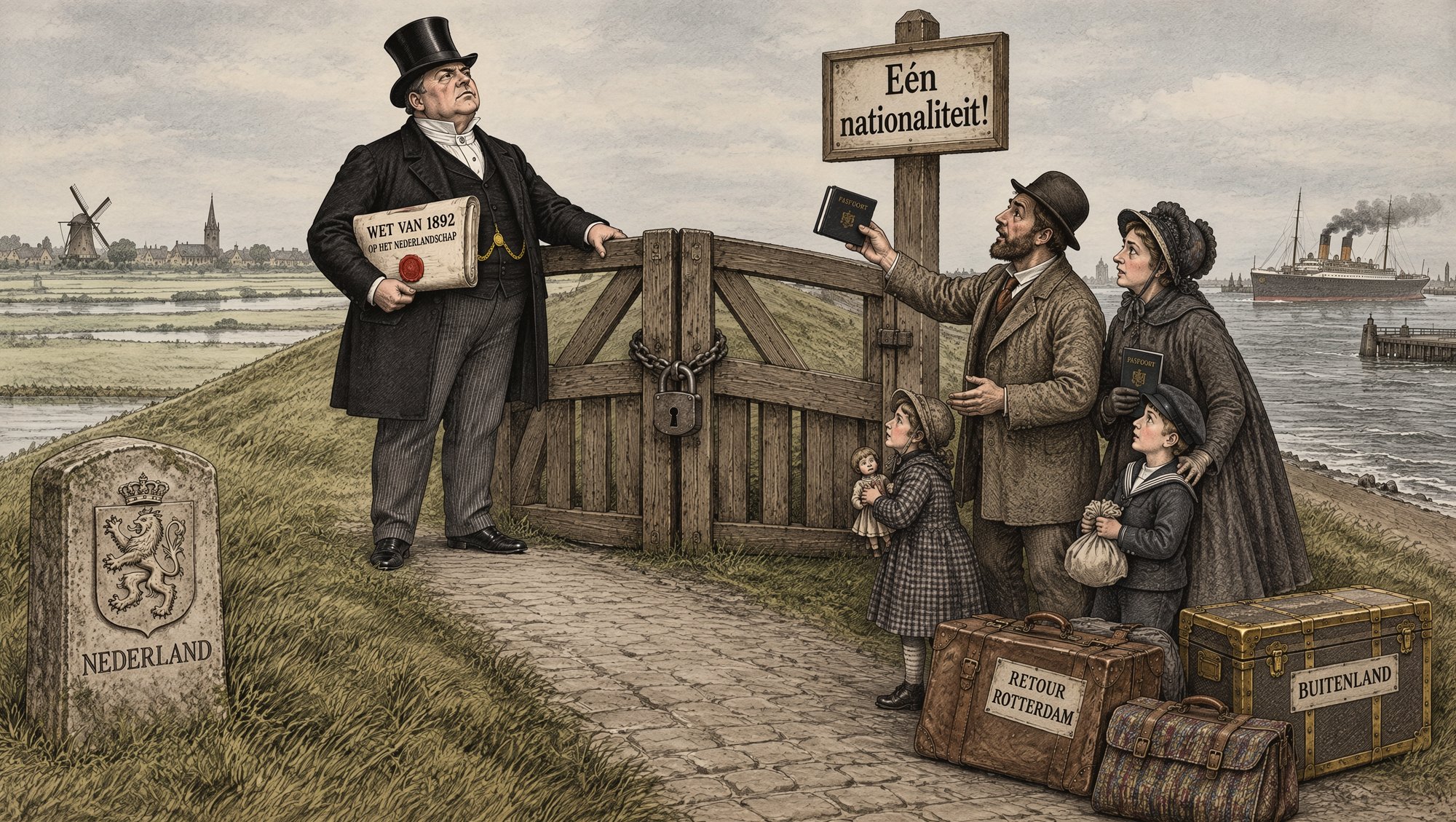
A lot promised, little done.
Ten months ago the Dutch parties D66, VVD and CDA presented their coalition agreement, “Aan de slag” (“Getting to work”). It says a lot about nationality: about Dutch nationals abroad, about newcomers, about naturalisation, about the language requirement. Time to take stock. What has happened since? And what has not?
Let us be honest: mostly the second.
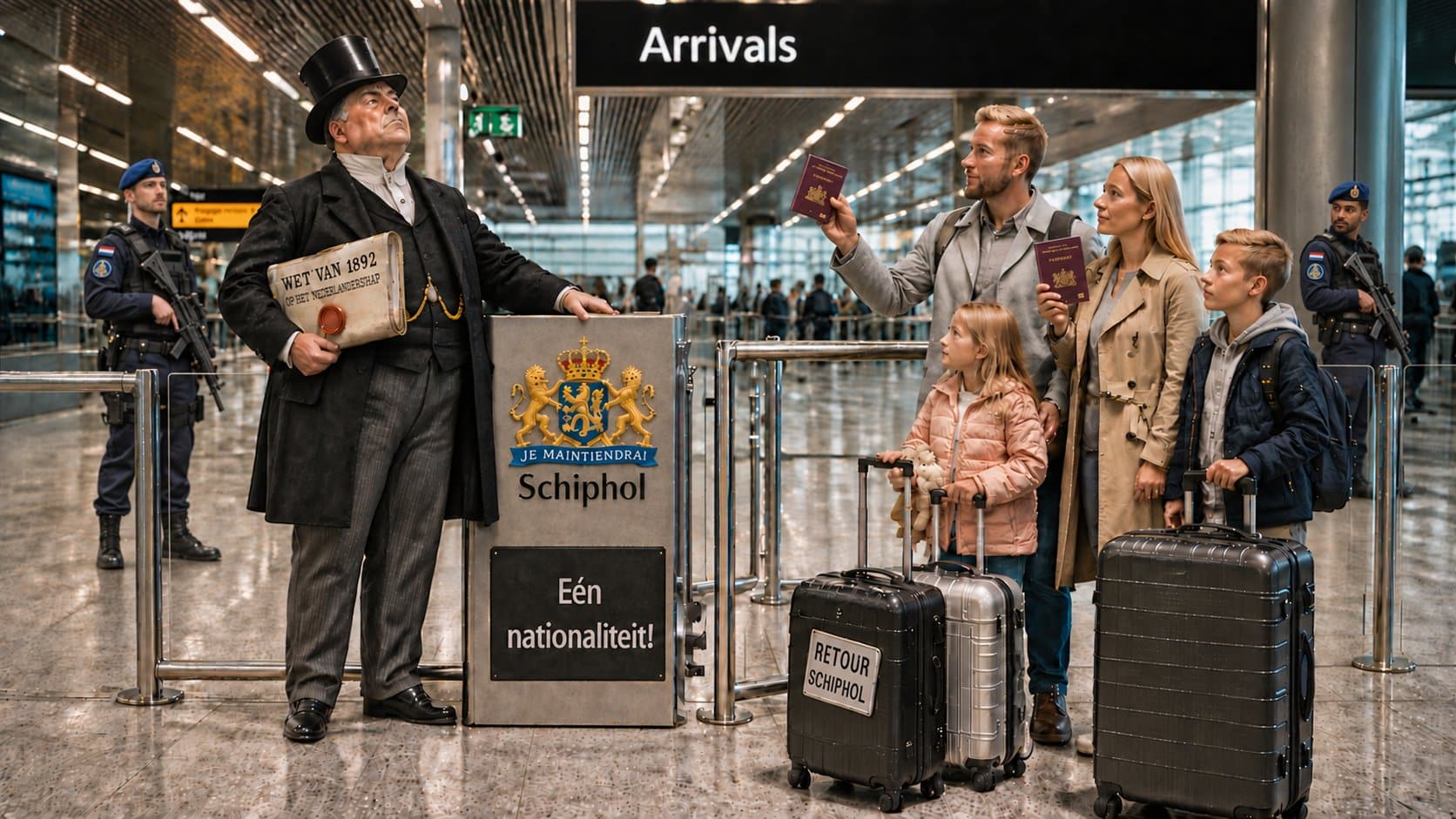
BREAKING NEWS!
In the past two days in The Hague, a proposal to change the law of less than half a page has been loaded with twenty amendments that reopen the whole Dutch Nationality Act: naturalisation only after ten years, a switch to stop naturalisation and the option route completely, taking Dutch nationality away from children, and leaving a human rights treaty because it is in the way. Some politicians clearly think we are in Germany a century ago.
Read my reaction: Twenty amendments in two days – and they don’t only hit terrorists
1. Dual nationality: the 2016 proposal is still waiting
It is ten years ago now: on 16 December 2016, members of the Dutch House of Representatives put forward their own proposal to change the law and modernise Dutch nationality law (parliamentary paper 34 632). At the time by Sjoerdsma (D66) and Marcouch (PvdA); since January 2024 defended by Jan Paternotte (D66) and Songül Mutluer (GroenLinks-PvdA, now PRO). The proposal:
- scraps the duty to give up your original nationality when you naturalise;
- scraps the automatic loss of Dutch nationality when a Dutch national voluntarily takes another nationality;
- scraps the loss through living a long time outside the Kingdom and the European Union (the well-known “13-Year Clock”);
- and gives anyone who lost Dutch nationality on or after 01 April 2003 an option right to get it back (but not those whose nationality was taken away).
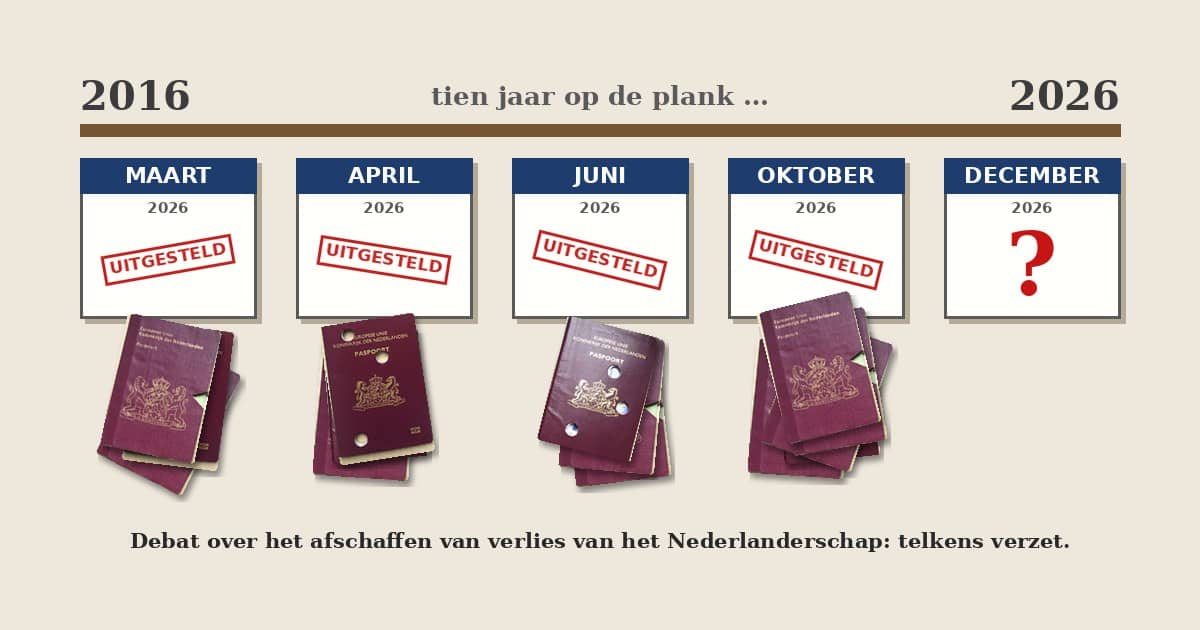
Almost ten years later it is still a proposal. The debate in the full House was planned for March, then for 06 April, then for June, then for 06 October. The debate is now set for week 51, the week of 14 December 2026.
Stichting GOED, the organisation that stands up for Dutch nationals abroad, wrote to the House’s standing committee for Justice and Security on 05 November 2026. GOED asks three things: end the automatic loss of Dutch nationality completely, allow multiple nationality, and repair for former Dutch nationals who lost their nationality from 1985 onwards.
Will it finally happen? I dare not promise it. I know the pattern. At every election since 2016 you hear the same thing: we will look at it, we will make it better, we will get rid of that clock. After the election it goes quiet. The proposal is on the agenda now, but that agenda keeps being moved.
What the coalition agreed
The coalition agreement of 30 January 2026 says, word for word:
“By modernising the nationality law, Dutch nationals abroad will not lose their nationality more quickly than applies for our neighbouring countries Germany, Belgium, France and the United Kingdom. For newcomers who want to naturalise in the Netherlands, the starting point is that they give up their other nationality.” (our translation)
Two sentences, two standards. For the Dutch national abroad: “not more quickly than” the neighbouring countries. What does that mean? Since 27 June 2024, a German no longer loses German nationality on taking another one. Nor has a Belgian since 28 April 2008, and the French and the British do not lose theirs that way either. Take “not more quickly than the neighbouring countries” literally, and for taking another nationality you end up with: “not”. So no loss.
Is that what the coalition means by “not more quickly than the neighbouring countries”? Then it could have written it that way. For the newcomer in the Netherlands: no, giving up the other nationality remains the starting point.
Stichting GOED calls the sentence a compromise: it meets the more than one million Dutch nationals abroad halfway, while stricter demands stay in place for newcomers. “It is not an ideal situation,” says Antonietta Sgherzi of GOED, “and you run the risk that objections will be raised here too, because of the principle of equality.” (our translation)
And D66, the party that co-wrote and defends the 2016 proposal, signed that agreement. In December, will D66 defend its own proposal, or the agreement?
Who said what
On 03 September 2026, Stichting Nederlanders Buiten Nederland (SNBN, the foundation for Dutch nationals outside the Netherlands) held its Day of the Dutch outside the Netherlands at Nieuwspoort in The Hague, with dual nationality as the main theme.
- Bente Becker (VVD), according to the SNBN report, told a room that included several former Dutch nationals who had lost their nationality against their will: “you are all simply Dutch”. To newcomers it sounded different. DutchNews quoted her: “If you come to the Netherlands, you have to really opt for the Netherlands.” Without changes the VVD does not support the proposal, and according to her the CDA thinks the same. According to the reports she was also critical of dual nationality for people who come to the Netherlands, pointed to the warning of the AIVD (the Dutch security service) about unwanted foreign influence, and the VVD believes the problems of Dutch nationals abroad can be solved separately from those of foreigners in the Netherlands. De Volkskrant summed it up that same evening: the VVD wants to help Dutch nationals abroad, but opposes immigrants keeping their original nationality.
- Jan Schoonis (D66), according to the reports, called the current law “harsh”.
- Fatihya Abdi (PRO) called its consequences “tragic”.
- The CDA and BBB were announced, but once again did not come. I found no statement this year by name from the CDA about the proposal. The CDA’s 2025 election programme does say that terrorists with dual nationality lose their Dutch nationality. I do not have much of a problem with that myself, but it sounds as if it is a big problem. The CDA apparently does not compare the numbers. In the talks we have with politicians, the CDA keeps its distance; it comes down to “rather not”. I do not find that very Christian.
And that AIVD warning Ms Becker pointed to: which warning? I have seen no warning from the AIVD about Dutch nationals abroad, new Dutch nationals or former Dutch nationals. Has she? It is easy to point to the AIVD, but I am not sure the AIVD appreciates it. Creating confusion by association is not a good look.
- The PVV has always been clear. When the Dutch Senate dealt with a small Brexit exception on 23 June 2020, Van Hattem (PVV) warned that it set a precedent: “Not having dual nationality is actually being undermined by this.” (our translation) So even offering Dutch nationals in the United Kingdom a way out went too far for the PVV.
When, some time ago, I spoke to some right-wing politicians in the corridors in The Hague about former Dutch nationals, it was different. Then I was told: yes, keeping and repairing nationality for Dutch people, fine, but not for those foreigners. I will not go further into that discussion here; that is a separate chapter.
The conclusion SNBN drew itself: there is no majority for the proposal as a whole, but probably there is for Dutch nationals abroad. In The Hague, so I hear, there is talk of an amendment: Dutch nationals abroad may keep their nationality, and newcomers must still give up their other nationality.
Stichting GOED heard the same. In a conversation with the VVD (its section for members abroad), it turned out that the party only supports the proposal if it is specifically about Dutch nationals abroad. GOED sent a position paper to almost all parties in April 2026 and in early November asked to meet members of the House from several parties.
My questions
Sounds reasonable? Look at how it works in practice.
Many naturalised Dutch nationals already have dual nationality, and the law says that is fine. Someone married to a Dutch national does not have to give up their nationality when naturalising. Nor does someone from a country that does not allow giving it up. Nor does someone who becomes Dutch as a minor. The “starting point” has so many exceptions that in many cases it is no longer a starting point. And the Netherlands did not always choose those exceptions itself; some were forced on it through international agreements.
When people in The Hague think of dual nationality, they think of the immigrant who comes to the Netherlands, not of the Dutch national who leaves. But even then the reasoning does not hold. Someone who may keep their original nationality does not have to put everything on one card, and can more easily go back to the country they came from. So whoever wants people to leave should actually be for dual nationality, or else try to abolish naturalisation altogether.
Meanwhile, the Dutch national who lives in Australia, the US, France, Canada, Germany or South Africa and takes citizenship there automatically loses Dutch nationality. Often without knowing it. There are exceptions, but they also often cause confusion. If my neighbour can, why can’t I!?
Most European countries have changed their minds by now. Other countries have their own limits, but only the Netherlands and Austria are still bound by chapter I of the Strasbourg Convention of 1963, the treaty meant to limit multiple nationality. Belgium, Denmark, France, Italy, Luxembourg and Norway left that chapter; Germany even left the whole treaty in 2001. The 2016 proposal would take the Netherlands out of it too.
And what do the people it is about think? Stichting GOED asked 5,275 Dutch nationals abroad in 2019. 78.1% want dual or multiple nationality to be allowed; 92.4% do not think taking another nationality leads to disloyalty. 5% of the participants turned out to have lost Dutch nationality without knowing it; GOED estimates this concerns about 50,000 Dutch nationals. In a more recent GOED poll of more than 3,000 Dutch nationals abroad, 93.5% were in favour of dual nationality and 96.8% in favour of an accessible way to get Dutch nationality back.
So: what are we actually worried about? And if one group may have two passports and the other may not, does that stand up against the principle of equality? That question was asked at Nieuwspoort too. No answer came. So that is discrimination written into law. A single woman loses her Dutch nationality; she should have got married. If you live inside the Kingdom or the EU, you do not lose your Dutch nationality through the so-called 13-Year Clock; if you live outside, you do. Equality? Or a difference because of where you live or whether you are married?
2. Taking away Dutch nationality: from temporary to permanent
Since 2017 the minister can take away the Dutch nationality of someone with dual nationality who has joined a terrorist organisation abroad (article 14, paragraph 4, of the Dutch Nationality Act). That rule was temporary, was extended in 2022, and according to the official overview of changes ends on 01 March 2027.
On 02 July 2026, proposal 36 984 was put forward to make it permanent. The coalition agreement supports that: someone with dual nationality who joins a terrorist organisation loses Dutch nationality.
Notice how that works. Dual nationality is unwanted, except when it is needed to take someone’s Dutch nationality away. Then it is suddenly very useful.
3. Naturalisation: ten years, six years, or just five?
The ten-year proposal
On 26 September 2025 the previous Dutch government (Schoof) put out a proposal to change the law for public consultation: the waiting time for naturalisation would go from five to ten years. The consultation ran until 02 December 2025. After that:
- on 23 January 2026 the Advisory Board on Regulatory Burden (ATR) advised not to put the proposal forward in its current form: its purpose is not clear enough from the explanation;
- in February 2026 the IND finished a check on whether it can be carried out in practice;
- on 20 February 2026 the minister wrote that the aim was “to submit it to the House of Representatives in the third quarter of 2026” (our translation).
The third quarter is over. On 06 November 2026 the proposal had still not been sent to the House.
I found no document from 2026 in which the Jetten government withdraws the ten-year proposal or changes it to six years. That absence says something too.
The coalition’s six years
The coalition agreement says:
“The permanent residence permit disappears under the European migration pact, and because of that someone can no longer naturalise as a Dutch national on the basis of such a permit. We therefore make naturalisation possible on the basis of a temporary residence permit, but we do raise the bar compared with before. Someone who has been granted a temporary residence permit twice and meets a language requirement at level B1 may naturalise after 6 years. For those for whom meeting a language requirement is impossible, a hardship clause applies.” (our translation)
Read that carefully. In my view this is not about everyone. It is about people living in the Netherlands on a temporary (asylum) permit: two temporary permits, and then six years. That is my reading; the agreement does not really make it clear. It is even unclear and gives an impression that may not be quite right.
What does that mean for everyone else: the skilled migrant, the student who stayed, the partner? Does their waiting time stay at five years? Will it still become ten? The agreement does not say. The government does not say. As far as I know, nobody in politics says.
4. “The permanent residence permit disappears under the migration pact” — is that right?
Half.
What is right: since 12 June 2026, the day the European Pact on Migration and Asylum started to apply, the Netherlands no longer grants new permanent asylum residence permits. Anyone who already had one on that day keeps it.
What is not right: that the pact forced the Netherlands to do this. The government said such a permit was no longer possible under the new European Qualification Regulation. The Council of State did not agree: abolishing it does not necessarily follow from EU law (as the Dutch law journal NJB summarises the advice). The immigration law committee of the Netherlands Bar put it even more briefly: “The Qualification Regulation does not forbid granting a permanent asylum residence permit.” (our translation) So it was a choice, not an obligation.
And what does not disappear: the regular permanent residence permit and EU long-term resident status still exist. The government itself names them as alternatives.
Why this matters for naturalisation: someone who wants to naturalise must have no “objections to permanent residence”. With a temporary asylum permit that was often not possible, according to the Council of State. By abolishing the permanent permit, the normal road to naturalisation disappeared for refugees. The six-year rule is the repair for that.
So first abolish something the pact did not require, and then build a new route to close the gap. And we call that “raising the bar”?
5. The B1 language requirement: forgotten?
No, not forgotten. But postponed again and again.
For naturalisation, the Dutch language level is still A2. Raising it to B1 was announced back in 2018. In 2024 the government wrote that it would not go ahead because there was no money: B1 exams go through the State Exams, and those are more expensive. B1 was in the 2024 outline agreement again. And in the 2026 coalition agreement again.
On 30 September 2026, Claire Martens-America (VVD) asked the minister when it will finally happen, and whether the proposal will go to the Council of State before the end of 2026. Minister Bart van den Brink (CDA, Asylum and Migration) answered on 03 November 2026: the process has “started”, it is “the intention” to put the proposal out for consultation this year, then the Council of State will follow, and then it will take effect “as soon as possible” (our translation).
A date? None.
There is also a practical question nobody asks: B1 has to fit with the hardship clause in the agreement and with people who naturalise abroad, at an embassy. What will that look like? On that too: silence.
6. Married to a Dutch national: what happens to the three years?
Today, the foreign spouse or registered partner of a Dutch national can naturalise after three years of marriage and living together, even if those three years were entirely abroad. Note: not from the country of which the partner is a national.
The ten-year proposal turned that into five years. The coalition agreement says nothing about partners.
So what will it be? Three years, five years, or something with “two temporary residence permits”? And will living together abroad still count? For the many international families outside the Netherlands, that is not a detail. It touches the family life of everyone who dares to fall in love across borders with a foreigner and wants to become, and stay, a family.
7. What does this mean for you?
- Nothing has changed yet. As long as a law has not been passed and has not taken effect, the current rules apply: five years, A2, three years for partners of Dutch nationals.
- Do you already meet the conditions? Then do not wait. Under the consultation version of the ten-year proposal, only applications made before the change takes effect would fall under the old waiting time. Transitional rules in nationality laws are rarely generous.
- Do you live outside the Kingdom and outside the EU, and do you have (or will you soon have) another nationality? Even if an exception applied to you when you took that nationality, you can still lose Dutch nationality later, through the 13-Year Clock. I call that loss in the second instance. The clock restarts when a passport, ID card or certificate of Dutch nationality is issued, not when you apply. If the embassy is slow, you carry the risk. So apply in time and keep the proof: it is up to you to prove it. Back then we asked for the clock to be abolished. The answer was: we will make it thirteen years. The 2016 proposal is not yet law.
- Are you a former Dutch national who lost Dutch nationality on or after 01 January 1985? Then politics may forget you. They apparently want to keep 01 April 2003 as the cut-off date. Make yourself heard and follow the debate in December (not yet postponed). That is exactly what Stichting GOED is asking the House: repair for former Dutch nationals who lost their nationality from 1985 onwards. GOED calls on people to keep writing to members of the House, to share their story and GOED’s messages, and to stay involved after the debate (stichtinggoed.nl). The option right in the proposal is meant for loss from 01 April 2003. If you lost it earlier, this proposal does not help you. My website has the story of six women who lost their Dutch nationality, often without wanting or knowing it.
I will keep following it. And I still hope the law will be modernised so that I am out of work in this field.
Translated from the Dutch original of 19 November 2026; quotes from Dutch documents are our translation. This is general information, not legal advice about your situation.
Sources
- Coalition agreement D66, VVD and CDA, “Aan de slag”, 30 January 2026
- Dutch treaty database (verdragenbank.overheid.nl), Convention on the Reduction of Cases of Multiple Nationality, Strasbourg 06 May 1963 (Trb. 1964, 4): status of parties and withdrawals from chapter I
- Parliamentary paper 34 632 (R2080), no. 6 (2023), article I, part B: new article 6(1)(r) of the Dutch Nationality Act — option for anyone who lost Dutch nationality “at any time on or after 1 April 2003”, unless it was taken away under article 14(1) to (4) (opened 12 November 2026); file checked on tweedekamer.nl on 13 November 2026: papers up to and including no. 10 (memorandum in reply to the report, 22 August 2025), no memorandum of amendment and no amendment
- Parliamentary paper 34 632 (R2080), no. 7: the proposal withdraws from chapter I of the Strasbourg Convention and the Second Protocol
- Belgian Federal Public Service Foreign Affairs, “Loss, retention and recovery of Belgian nationality” (diplomatie.belgium.be)
- German Federal Ministry of the Interior, Act to Modernise Nationality Law, in force 27 June 2024; German Federal Foreign Office, FAQ on the new nationality law
- Dutch House of Representatives, long-term agendas with 34 632 by date drawn up: 05 December 2025 (week 13, 24-26 March 2026), 16 February 2026 (2026D07406, week 15, 07-09 April 2026), 17 April 2026 (week 24, 09-11 June 2026), 29 May 2026 (week 36, 01-03 September 2026), 17 July 2026 (2026D37030, week 41, 06-08 October 2026), 04 September 2026 (2026D41044, week 50, 08-10 December 2026); opened 13 November 2026
- Stichting GOED, “Voor de vijfde keer uitgesteld, wanneer is het wel belangrijk?” (“Postponed for the fifth time”), 13 June 2026, and report of the Day of the Dutch outside the Netherlands of 3 September 2026 (06 October as the planned debate date)
- Dutch House of Representatives, file 34 632 (R2080); plenary debate week 51 (activity 2025A06255), opened on tweedekamer.nl, 12 November 2026
- Parliamentary paper 36 984 (R2222), no. 1 (put forward 02 July 2026); overview of changes to the Dutch Nationality Act on wetten.overheid.nl (read 06 November 2026)
- Minister’s answer to parliamentary questions, 20 February 2026 (aim to submit in the third quarter of 2026)
- Advisory Board on Regulatory Burden (ATR), advice of 23 January 2026
- IND, implementation check of the proposal to change the Dutch Nationality Act, February 2026; IND website on naturalisation of partners of Dutch nationals
- Council of State, advice on the Implementation Act for the Pact on Migration and Asylum 2026; Stb. 2026, 128
- Letter to Parliament of 03 June 2024 on the language requirement for naturalisation; answer of minister Van den Brink to questions from member Martens-America (received 03 November 2026, 2026Z20516)
- Proceedings of the Dutch Senate, 23 June 2020, debate on the temporary exceptions to the Dutch Nationality Act (Brexit), interruption by Van Hattem (PVV)
- NJB, summary of the Council of State’s advice and Stb. 2026, 127 and 129 (Implementation Act for the Pact on Migration and Asylum 2026); Netherlands Bar (NOvA), Advisory Committee on Immigration Law, advice on the same proposal
- AIVD and NCTV, “Over de grens. Statelijke inmenging in diasporagemeenschappen in Nederland” (state interference in diaspora communities in the Netherlands), October 2024, p. 34; AIVD, public annual reports 2024 and 2025 (no passage on nationality or dual nationality)
- Stichting Nederlanders Buiten Nederland (SNBN), newsletter 09 September 2026; Stichting GOED, report 03 September 2026; de Volkskrant, 03 September 2026; DutchNews, “Some Dutch people are about to be more equal than others” (September 2026)
- Stichting GOED, letter to the standing committee for Justice and Security, “Inbreng Stichting GOED – wetsvoorstel modernisering nationaliteitswetgeving (34 632 / R2080)”, 05 November 2026
- Stichting GOED, position paper to the House of Representatives on proposal 34 632, 07 April 2026
- Stichting GOED, Nationality survey 2019 (08 October 2019), stichtinggoed.nl/Nat_Onderzoek.pdf
- Answers from Stichting GOED to the author, 15 November 2026
This post reflects the position on 19 November 2026. The law and the practice may have moved on since.