
Published 30 October 2026
This article is about six clients. Their names and some identifying details have been changed; the heart of their stories has not. All six were born and raised in the Netherlands. None of them wanted to lose her Dutch nationality, and none of them did anything she was not allowed to do. Yet it went wrong for all six. Sometimes because of the law itself, which works automatically and without warning. Sometimes because of the people who should have shown them the way. When nationality comes up in the Netherlands we tend to think of immigrants who want to become Dutch, or who have become Dutch. But it is very often the Dutch themselves who are affected. Most of my clients are Dutch nationals, or former Dutch nationals.
The regulations formally call these people oud-Nederlander — literally “old Dutch national” — but old is usually what they are not. Every age is affected, from toddlers born in the Netherlands to people drawing a pension. “Former Dutch national” is the better term.
Sarah: losing Dutch nationality while living in the Netherlands
Sarah has an Australian father, but she lived in the Netherlands all her life. As an adult the bond with her father becomes more and more important to her. People around her tell her she can get an Australian passport. That would make a dream trip, an adventure in Australia, a good deal easier. Through her father she feels connected to the country, and she goes for it.
The Australian authorities tell her she can have a passport, but that she must first register as an Australian. Sarah understands that the way it looks to her: she is registering what she has been since birth, through her father. An administrative step.
Unfortunately that is a common misunderstanding. Sarah was not Australian from birth, and the registration does not confirm something that was already there. It is not an application for naturalisation, but it is not an administrative recognition of an existing nationality either. It is an act by which she acquires Australian nationality voluntarily. And Dutch law then provides that she loses her Dutch nationality automatically and immediately. No official, no judge and no procedure is involved; the law works automatically and at once.
Sarah does not notice at first. Nor does the government. So for a short while she lives in the belief that she holds both nationalities. Until a friend asks whether that is not a problem: he had heard that you can lose your Dutch nationality if you take another passport. Sarah seeks advice, and the officials at her municipality give her contradictory information. That is how she reaches me, and I have to break the news: she is no longer a Dutch national.
The passport itself is not the problem. A passport is a travel document, a piece of paper to travel on. It is connected to nationality, but it is not the same thing. Nationality is a status: you have it, or, like Sarah, you no longer have it. Without realising it, she has become a foreigner in her own country. She has not been allowed to work for some time, nor to stay in the Netherlands. She is very worried, sad and frightened. What now?
We put a number of solutions to her. With a bit of luck the IND, the Dutch immigration service, will see the situation for what it is and will not make it too difficult. We apply for a residence permit for her as a former Dutch national, born and raised in the Netherlands. That allows her to go on living and working here. After a year she can recover her nationality through one of the many available routes. Fortunately she gets her residence permit quickly and without difficulty. Next year she will be Dutch again, and as far as the Netherlands is concerned she may keep her Australian nationality as well. The year as a foreigner in her own country does bring its share of bureaucratic difficulty. But it comes right in the end.
Anita: “de facto” is not a marriage
Anita was also born and raised in the Netherlands. As a young adult she sets off for New Zealand and finds love there. She deregisters in the Netherlands and lives with her New Zealand partner in the land of the kiwis. There their relationship is treated as equivalent to marriage for tax, immigration and all manner of other government purposes. With her residence permit she also receives confirmation that her “de facto relationship” has been accepted.
In the Netherlands too, people who live together have many of the same rights as married couples, and so Anita sees her status as equivalent to marriage. She checks with the Dutch government and is told that a partnership recognised abroad is equivalent to a marriage. For her that is a green light to apply for New Zealand nationality. After all, she falls under an exception and so will remain Dutch — or so she thinks.
The information she was given was very nearly correct in itself, but it was not about her. The officials failed to explain that a “de facto” status is not a recognised registered partnership. Anita did intend to marry, but wanted to wait until her family could come to New Zealand. So she became a kiwi and at that same moment lost her Dutch nationality, automatically. Unknowingly and unintentionally. The marriage a few months later makes no difference any more.
Only later does she hear, second hand, that “de facto” may not count. She contacts me and is given the news. She is very upset and sad: she never wanted to lose her nationality. Her parents are getting older, and the plan had already been to go and care for them.
We propose the same residence permit as for Sarah. Anita wants to make the application herself. She is now, at a young age, suddenly a former Dutch national, and she expects her entitlement to that permit to be clear and strong. Strong it is, too, because she was born and raised in the Netherlands. But she comes back to us later: her application has been refused, because according to the IND she is still a Dutch national. In the Non-residents Records Database she is still recorded as Dutch, and the IND decision officer follows that. The law itself is ignored in the process. That surprised me as well.
Anita is by then already on her way to the Netherlands and contacts us again. We have a solution, but we are now heavily dependent on the IND. It comes right, but she still cannot start the job in the Netherlands. According to this IND officer she could: the IND states in black and white that she is a Dutch national, and a Dutch national may return and work in the Netherlands at any time. Strong rights on paper, then, but a surprising lack of clarity from the IND, which should have known better. Pointed to the error, the IND is unwilling simply to acknowledge it and directs Anita towards an objection that can take a long time, a very long time. Meanwhile her family life and her work are disrupted.
Barbara: Italian without knowing it, and a Clock she had never heard of
Barbara too was born and raised in the Netherlands, the daughter of a Dutch mother and an Italian father. Her father dies young; Barbara is six at the time. A traumatic period. In the Netherlands she is always registered as Dutch, and nobody gives the Italian nationality a thought.
As an adult Barbara moves to Canada. She stays there, living and working. During covid the embassy is often closed and slow to renew her passport. Without knowing it, Barbara lost her Dutch nationality: through a nationality she did not know she had, and through a Clock she had never heard of.
Barbara gets in touch. We advise her to apply for an Italian passport first, so that she can at least travel. But the Italians do not make the paperwork easy either, and they are slower still than the Netherlands. In the end it comes down to this: as a Dutch-speaking Italian, with her rights as an EU citizen, Barbara can travel to the Netherlands and live there more easily than she could as a former Dutch national.
Louise: the exception that does not protect you forever
Louise was also born and raised in the Netherlands. In New Zealand she meets a kiwi. They marry, she becomes a New Zealander and, because of her marriage, is allowed by way of exception to keep her Dutch nationality.
Then Louise develops cancer, and money is tight. The couple decide to go and work in Germany after her treatment: better jobs, and closer to the family in the Netherlands, whom they miss badly across such a distance. Because of her illness she cannot travel, the embassy is far away, and her passport is not renewed in time. She does not really dwell on it; travelling was only planned for later. She had telephoned the embassy earlier to ask whether a late application was possible. It was, she was told. No warning about a ten-year Clock.
She recovers, they find good jobs in Germany, but her passport application is refused. She has lost her Dutch nationality through a Clock she had never heard of. On being refused she pleads for help and asks how she can get her Dutch nationality back. She cannot, she is told, unless she moves back to the Netherlands, and for that she would need a residence permit she cannot get. Again incomplete, and therefore incorrect, information. The jobs in Germany fall through.
A few years later she hears about me and makes contact. There were other possibilities after all, even then. Here too it comes right in the end, but far too late.
Marion: Dutch and only ever Dutch, yet stranded without a passport
Marion too was born and raised in the Netherlands. She is somewhat older and, after a successful career, takes early retirement in Spain. It suits her well. She follows a friend to Costa Rica, and that suits her better still.
After some eight years in Costa Rica she falls ill and cannot renew her passport unaided. She asks the embassy for help, for a visit from a consul, but none comes. She does not need financial help; only her passport, from her hospital bed. Without a valid passport she cannot renew her residence permit either, and it expires.
When she is a little better she goes to the embassy herself. Because she no longer has a residence permit she is asked to prove that she is still Dutch, that she has not become Costa Rican in the meantime. She has to produce a statement from the Costa Rican government that she is not Costa Rican. She cannot obtain one anywhere without a valid passport. At the immigration service’s head office she is warned that she could be arrested. She applies for a passport again and is again refused at the counter. She is not even given the chance to make a formal application and pay for it. She is referred back to the local authorities.
This time she is indeed arrested and detained. The embassy is informed and says there is nothing it can do: first she must prove that she is not Costa Rican and is still Dutch. The authorities in Costa Rica do see the problem and release her on conditions. She writes letters and looks everywhere for help. She falls ill again, and this time she can no longer reach her money either: without valid identification she cannot get a new bank card.
Eventually she hears about us. We make a noise, and after six years and a good many extra grey hairs she gets her passport. She has only ever been Dutch. But proud of the Netherlands she is not, any more. Because of the period without a residence permit, Costa Rican nationality is out of reach for her as well. She lives on, with suspicion.
Bregje: falling through the net
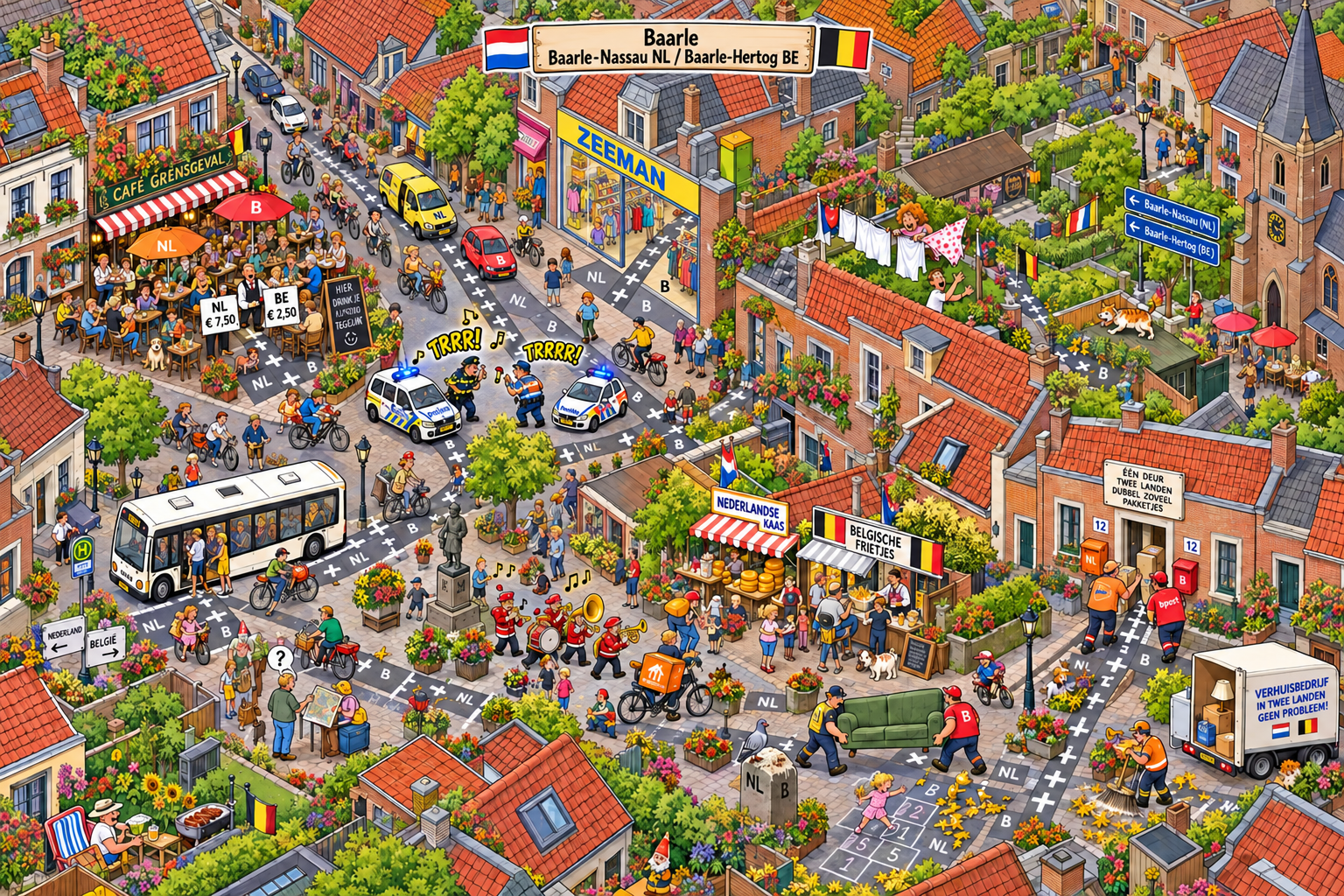
Bregje was born in the Netherlands, and raised there too — or perhaps not! Her two Dutch parents are living in Baarle-Nassau, so in the Netherlands, when Bregje is born. But when she is two they move to a house around the corner. That house stands in Baarle-Hertog, which is part of Belgium. Baarle is the most complex enclave village in the world, where the border between the Netherlands and Belgium runs criss-cross through streets, shops and houses. The members of the family are now Dutch nationals, all three born in the Netherlands, living a few doors away in a foreign country. Her father has his own business in Baarle-Nassau and over the years it grows well. Bregje spends her first few nursery years at a school in Baarle-Hertog and moves on through primary education and so on. As a teenager she spends a few more years at senior general secondary school in Baarle-Nassau.
But then her parents decide that Baarle is not southerly enough. Her father’s business is now large enough for the family to come and go as they please. They move to Australia. Bregje with the typical reluctance of a teenager who would rather have stayed in the Netherlands. Bregje adapts and takes her bachelor’s degree in Australia. Her parents fare less well and divorce. Her mother returns to the Netherlands. Bregje wants to go back too, but she has just started her master’s and wants to finish it.
Bregje is by now an adult and, while she finishes her master’s, her father moves to Spain: closer to his business in the Netherlands, and a fine country besides. Bregje completes her master’s. By then she has lived in Australia for eight years or so. She has built a circle of friends and a life there, and so has ties to both the Netherlands and Australia. Work in the Netherlands is not easy for her, given her field of study and her lack of experience. She decides to gain a year’s work experience. In Australia she cannot find work either. Employers there are less interested in someone holding a residence permit. They would rather have Australians. She experiences a degree of discrimination, and it becomes plain.
She is able to become Australian. Because of the difficulty over work, and so as to be able to come back easily later, she becomes Australian. Because she falls just outside one of the exceptions, she loses her Dutch nationality. She does not know this, and nor does the government. The rest goes well: she eventually finds the work she wanted, completes her one-year contract, sells her flat and moves to the Netherlands.
First she stops for a month in Spain to visit her father, who is battling cancer there. There she meets a Dutchman who listens to her proud account and remarks drily that she may no longer be Dutch. Worried, she goes looking for information. The embassy in Spain says she should write to the consulate in Sydney. Sydney says that loss is possible, but that it can say nothing about it unless she comes in to apply for a passport. She searches further and ends up with us. Unfortunately, yes: she is no longer Dutch.
We have some solutions in mind. She still wants to move to the Netherlands; in that case she applies as a former Dutch national for a residence permit, which will also allow her to work. Given her experience of discrimination in Australia she is, of course, hesitant. But for her purposes it is the best route. The difficulty is that she is now in Spain on her Dutch passport, which is no longer valid despite the expiry date printed in it. We have a solution for that too, a little creative, but legally correct. I will say no more about it here.
We apply for the residence permit, but note this: it is refused. The reason: Dutch immigration law recognises two kinds of people here. Those born and raised in the Netherlands, and those born and raised outside the Netherlands. Bregje belongs to neither and falls through the net. We had raised this at the application stage and offered solutions with supporting evidence. But the decision officer is unwilling to think along with us, and so we have to lodge an objection. In the objection we supply further evidence. One of the points is that those born and raised outside the Netherlands must show that they have more than ordinary ties with the Netherlands. Bregje’s father wants her to help in the business, and she is given a leading role. We prove his cancer, the job, and the explanation that this is a family business with dozens of staff who depend on day-to-day leadership: Bregje. Bregje’s mother has been struggling for some years with mental ill health because of the divorce and of missing her daughter. Bregje hears this for the first time when the news of the refusal sends her mother into a trough. So we can prove this as well: a need to support her mother.
In the end we get a simple answer: yes, the objection is upheld. No explanation of what was and was not acceptable, but there it is: Bregje may come to the Netherlands. She has recently recovered her Dutch nationality through a fairly simple option procedure and is now allowed to keep her Australian nationality as well. All told, Bregje and her family lived with eighteen months of uncertainty, and that is now thankfully behind them.
The children
Some of these women had children, who shared in the loss as minors. Some of those children were born in the Netherlands, others were not. One of them said recently: “I wish I had been born in the Netherlands, then I would still be a full Dutch person now and I could go and see granny.” That is not, sadly, how it works — but what matters here is the feeling. Children too are affected by this loss at a young age. Families are torn apart, and people are exiled from the country where they feel at home.
What does one of the women think?
At the proofreading stage this response came from one of those involved, and it is telling:
“What heartbreaking stories. Things are difficult for me just now, but I know that, relatively speaking, I have no right to complain. I am in a privileged position, in that I can apply for a residence permit in the Netherlands at all. That does not alter the fact that the bureaucracy and arrogance of the Netherlands are dreadful, and the solution is unfortunately not there yet for me. I hope that, with a little understanding, a good decision will be taken soon, but the first signs are not good. I hope the private member’s bill for former Dutch nationals will one day get through, so that others do not end up in the same boat.”
On the IND
The reader may now think that the IND is an organisation full of dreadful people. That is not right. The IND has plenty of good people who feel for their clients and think along with them, who come up with solutions and who care about their fellow human beings. Of course there are also those who make mistakes, or who really do have poor intentions. But on the whole they are good people. They work, however, with the means they are given, and knowledge is one of those. From within the IND I hear that many experienced people have left in recent years. New staff lack experience and knowledge. On top of that come the budgets and the pressure to do more with less. We all want to do the job well, but that kind of pressure is a danger to accuracy and to more besides. The legislation and regulations, and the way they are explained in circulars and policy, sometimes leave something to be desired as well. Unclear legislation that refers to “everything possible” or to “proportionality” leaves room to be filled in by those who write the policy and the instructions, or by the officer who takes the final decision. This is therefore not a complaint about the staff of the IND, but an alarm bell for society, for those who lead it and for the politicians. Produce better legislation, and modern legislation.
I wrote more about better legislation in my recently published little book “Lost by Operation of Law”
This post reflects the position on 30 October 2026. The law and the practice may have moved on since.