
Published 26 March 2026
One of these days, a debate will held in the Tweede Kamer (the Dutch House of Representatives) concerning an initiative proposal which will be celebrating its 10th anniversary this year. The subject? Dual nationality, and more specifically, ceased participation in the 1963 Convention on the Reduction of Cases of Multiple Nationality. If the Netherlands withdraws from this Convention, Austria would be left as the sole remaining participant.
This initiative proposal has been managed by several politicians, and debated throughout several governments. It remains to be seen whether the new coalition will have an impact on its continued treatment.
In any case, it has become abundantly clear that there is no real reason for this proposal to not succeed (desirable modifications notwithstanding). The Dutch government’s position is that possession of a single nationality should be the standard, and that dual nationality is an exception to the norm.
However, officially published statistics do not support this position.
During the period of 2018-2024, 316,046 naturalisation requests were submitted. Of these:
- 31% came from minors. Minors do not have an obligation to renounce foreign nationalities.
- 10% came from those married to a Dutch national, who are not required to renounce foreign nationalities
- 9% came from stateless persons, who do not have a nationality to renounce
- 13% came from persons who automatically lose their nationality upon acquiring Dutch nationality
- 50% came from persons cannot lose their other nationality due to the laws of those countries (Syria, Morocco, and Iran account for a great deal of these applications, Argentina well known for the Dutch Queen)
- An unknown number of applications came from adults who were either born and resident in the Netherlands, or who had otherwise lived in the Netherlands as minors for 5 or more years.
What does this mean?
This means that, of 316,046 people who requested Dutch nationality via naturalisation, 28,209 were requested to renounce their nationality. That is just shy of 9%. Of these, only 19,648 went through with the renunciation.
In other words, in the country where “single-nationality is the main rule”, only 6% of naturalisands renounced their other nationality.
What happens to those 6%?
Of the 6% of people who were required to renounce their original nationality when everything was said and done, most of these people would have been able to reacquire their original nationality where specific circumstances are met:
- The person was born in the country of that nationality, and has there principal residence there at the time of re-acquisition
- The person lived in the country of that nationality for at least 5 years as a minor
- The person has a spouse who holds that nationality
(NB: While these exceptions exist, proving eligibility is not always straightforward. When in doubt, please reach out!)
Given the number of people who either hold the nationality of the country where they were born, were raised for at least five years during childhood, and/or have a spouse with that nationality, the number of naturalisands who must undergo an “irreversible” renunciation may very well be under a single percentage point.
While this means that few people are affected, it does not negate the fact that there are still several thousand people each year who are unfairly required to go through a renunciation procedure while most others remain completely unaffected. In this way, the few select people who must actually comply with the so-called ‘single-nationality principle’ become the exception, and it is difficult to see how this system can remain in place.
Therefore, the renunciation requirement has become effectively meaningless, and it is time for the Netherlands to move on.
Written by Chloë Faucher
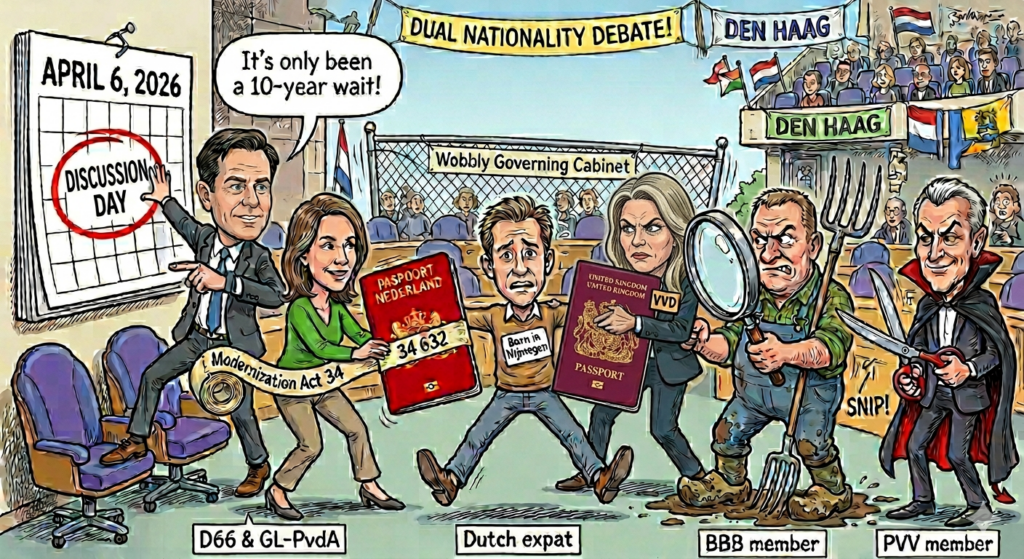
Image by AI. We, HKLS, asked AI anonymously to make an image on the upcoming debate about the 2016 proposal to change the nationality law. We gave no further instructions. Apparently this is what AI thinks on the subject.
Thus likely reflecting popular opinion on the internet and in society.
This post reflects the position on 26 March 2026. The law and the practice may have moved on since.